

Ante Coding Agent Review: Pros, Cons, Pricing, and Who Should Buy
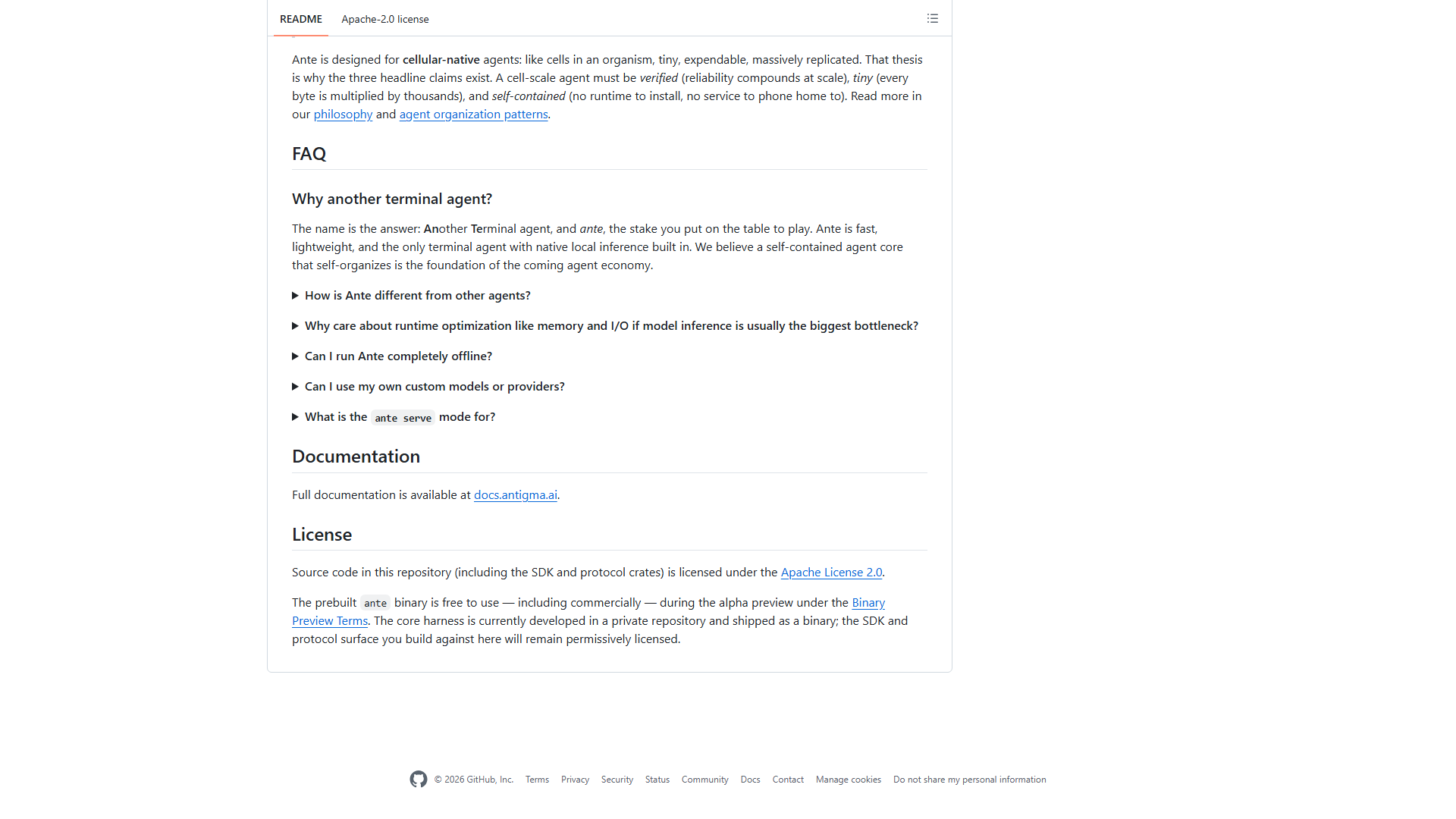
Ante is a local-first coding agent distributed as a single binary and designed to run without a mandatory cloud control plane. For developers who need an offline coding agent, that packaging choice matters more than marketing claims about autonomy. Review analysis shows that the practical question is not whether agents can edit code, but where inference runs, how coding agent setup is maintained, and which limits appear once teams treat Ante as a coding agent self hosted runner. This review weighs documented positioning from the official Ante repository against operational trade-offs versus cloud coding agents. <ul><li>Best fit: local and air-gapped engineering workflows</li><li>Core promise: offline-capable single-binary distribution</li><li>Main risk: model, tooling, and ops burden shifts to your machine</li><li>Buy signal: you control runners more than you need managed SaaS agents</li></ul>
What Is Ante Coding Agent and Who Is It For?
<strong>Quick navigation:</strong> Features and limits · Pricing reality · Critical gaps · Final verdict · FAQ
What is ante coding agent? In plain terms, Ante is an agent-style coding assistant packaged for local execution rather than as a browser-only SaaS workspace. The Ante GitHub project frames the product around a single binary that can run offline, which places it closer to self-hosted developer tooling than to hosted chat products.
The primary audience is developers who need an offline coding agent and engineers setting up self-hosted coding agents inside private networks. A secondary audience is teams that already accept local model or private endpoint costs and want agent loops to stay near the repository.
A practical takeaway is that Ante is less about replacing an IDE and more about keeping agent execution under operator control. Cloud agents optimize for managed convenience; Ante’s published direction optimizes for portability and reduced dependency on always-on vendor infrastructure.
How Ante Coding Agent Works in Local Workflows
How to use ante coding agent in practice usually starts with installing the binary, pointing it at a repository, and wiring an inference backend that your security policy allows. Documentation states the offline/single-binary emphasis on the project homepage, so local development fit depends on whether your model path also works without public internet.
One common concern is confusing “agent binary runs offline” with “every model call is free and local.” Offline packaging removes a hosted control plane requirement; it does not erase the need for a capable model runtime, credentials policy, and repository permissions.
Ante Coding Agent’s Standout Features (And Hidden Limitations)
Support documentation reveals that Ante’s strongest differentiator is distribution: an ante single binary coding agent that teams can place on a workstation or internal runner image. That reduces install surface area compared with multi-service stacks that need separate UI, worker, and queue components.
In this review, the ante offline coding agent angle is the feature buyers actually pay attention to. Offline capability helps regulated environments, travel laptops, and locked-down build machines. The hidden limitation is capability ceilings: offline usefulness tracks local/private model quality, tool integrations, and how completely the agent can act without external package indexes or APIs.
Compared with popular alternatives such as Aider and Continue, Ante’s public positioning stresses portable offline execution more than ecosystem plugins or IDE marketplace reach. Teams that want deep IDE embedding may still prefer Continue; teams that want terminal-centric edit loops may already use Aider; Ante competes on self-hosted simplicity rather than on the largest extension catalog.
Coding Agent Setup: Implementation Steps and Common Mistakes
A disciplined coding agent setup usually follows four steps: verify host OS compatibility, install the binary from the trusted source, configure the model endpoint or local runtime, then constrain filesystem and shell permissions to the target repo. Skipping permission boundaries is a common mistake because agents can propose broad file changes quickly.
Another frequent failure mode is treating first-run demos as production readiness. Teams forget pin versions, omit hash verification, or leave API keys in shell history. For self-hosted runners, also define CPU/RAM budgets and failure alerts before inviting the agent into shared branches.
When Ante runs as an internal worker, session visibility becomes an operations problem, not a feature checkbox. Engineers comparing agent platforms often study failure forensics next — including why agent observability gaps appear in production — because local autonomy without traces makes incident review slower.
The Real Cost: Ante Coding Agent Pricing Breakdown
Is ante coding agent free to use? The software is published publicly on GitHub, so many teams can evaluate the binary without a classic SaaS seat checkout. That does not mean total cost of ownership is zero: inference, GPU time, developer supervision, and runner maintenance still appear on the budget line.
According to the project’s public distribution on the Ante repository, there is no separate commercial pricing page in the provided product data for this review. Readers should confirm the current license terms and any paid offerings on that source before budgeting. Do not assume a fixed monthly SaaS list price from secondary summaries.
Cost analysis should split into three layers: (1) license/compliance cost of the agent binary, (2) model provider or on-prem inference cost, and (3) engineering time for coding agent self hosted runner operations. Cloud coding agents often bury some of layer three inside subscription packaging; Ante shifts more of that work back to your team.
Ante vs Cloud Coding Agents on Total Cost
How is ante coding agent different from cloud coding agents on money? Cloud products concentrate spend into seats, usage meters, and managed uptime. Ante concentrates spend into hardware, model hosting, and people who keep runners healthy.
For short experiments, a hosted agent can be cheaper in calendar time. For long-lived private codebases with strict egress rules, paying for local inference plus an ante offline coding agent workflow can be the only compliant path — even when cash spend is not the lowest sticker price.
Where Ante Coding Agent Falls Short (Critical Analysis)
What are ante coding agent limitations? The critical ones are operational, not rhetorical. Single-binary delivery simplifies install, yet it does not automatically provide enterprise SSO dashboards, multi-tenant policy centers, or turnkey evaluation harnesses that mature SaaS agents advertise.
Can ante coding agent run without an internet connection? It can run as an offline-oriented binary according to the project’s public positioning on GitHub, but full task success still depends on whether dependencies, models, and tools are available locally. Package downloads, issue trackers, and remote services break the offline assumption if you leave them enabled.
Does ante coding agent work as a self hosted runner? Architecturally yes for teams that place the binary on their own machines or CI workers. The gap is everything around the binary: queueing, isolation, audit logs, and blast-radius controls. Those are design choices your platform team must enforce.
Is ante coding agent good for local development? For repository-local edit/test loops under developer supervision, the fit is strong. For unmanaged autonomy on production branches without review gates, the fit is weak. Critical analysis favors Ante as a controlled assistant, not as an unattended release engineer.
Final Verdict: Is Ante Coding Agent Worth the Investment?
Ante coding agent is worth the investment when control, offline continuity, and self-hosted execution outrank managed convenience. It is a weaker buy when your team wants a turnkey cloud agent with centralized billing, vendor SLAs, and minimal platform ownership.
Buy Ante-shaped workflows if you already run private models or can accept local inference limits. Skip or postpone if your org cannot staff runner hardening, change review, and secret hygiene. The decisive variable is operating model maturity, not binary novelty alone.
Next steps for evaluators: clone and inspect the Ante source and release artifacts, validate offline model paths on a non-production repo, measure supervision time per merged change, then decide whether a coding agent self hosted runner belongs in your standard developer platform.
Should You Choose Ante Coding Agent?
The evidence-backed case for Ante coding agent is strongest for offline and self-hosted scenarios where a single binary reduces install friction and keeps execution inside your boundary. The case weakens when you need managed governance more than local control.
Treat Ante as infrastructure you operate, not as a hands-off SaaS seat. If that ownership model matches your constraints, the investment thesis holds; if not, a cloud coding agent will likely waste less platform time.